

 Language
 Language
Advanced Equipment
We have Laser Cutting Machine, CNC bending machine, Spot Welding Machine, Polishing Machine,Fixed bench press, air plasma cutting machine, platform CNC punch, CNC hydraulic guillotine shear, four-column hydraulic press, universal lifting table milling machine, radial drilling machine, hydraulic digital display sheet Bending machine,
Production Market
Our products have been exported to Russia, USA, France, Namibia, Saudi Arabia, Thailand, Uruguay, Singapore, Spanish, Germany, Cyprus,Botswana, Korea, Switzerland,Newzeland, Pakistan, Brazil, Malaysia, Spanish, Peru, Chile,Turkey, Portugal, etc.
Our produck
Our produck have Vibrating Screen, Screw Conveyor, Belt Conveyor, Vacuum Conveyor, Bag Dumping Station.
Quality Management
We are qualified with ISO quality management system and CE certificate, all the main components are fine manufactured in our own factory with strict inspection, and quality is always our priority.
Vibrating screens are used to separate and classify different sizes of particles in a material. The basic principle of a vibrating screen is the vibration generated by the screen's eccentric, or unbalanced, mass, which is driven by a motor. The screen's vibration is generated by the centrifugal force of the unbalanced weight on the drive shaft. This vibration causes the material to be separated into different sizes based on the size of the particles.
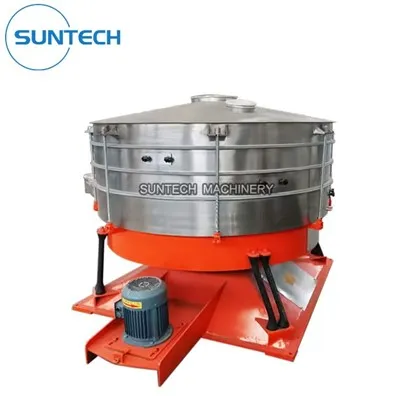
The vibrating screen is made up of a screen mesh or a sieve surface, a vibrator, and a vibration damping device. The screen mesh is made up of wires or synthetic fibers, and the sieve surface can be made of various materials, such as metal, rubber, or plastic.
The vibrator is mounted on the screen's side plate and consists of a motor with an unbalanced weight attached to the end of the drive shaft. The motor drives the drive shaft to rotate, and the unbalanced weight generates the centrifugal force that causes the screen to vibrate.
As the material to be screened is fed onto the screen, the vibrating motion of the screen causes the material to separate into different sizes. The smaller particles fall through the screen's mesh and are discharged, while the larger particles continue to vibrate until they reach the edge of the screen and are discharged.
The vibration damping device is used to reduce the vibration transmitted to the ground and to the supporting structure of the screen, which can reduce noise and prevent damage to the screen.
The working principle of a vibrating screen involves the vibration generated by an eccentric or unbalanced mass, which is driven by a motor. The vibration separates the material into different sizes based on the size of the particles, and the vibration damping device reduces the vibration transmitted to the ground and supporting structure.
Vibrating Screen Types
Linear vibrating screen
The linear vibrating screen utilizes double vibrating motors that rotate in opposite and synchronous directions. This creates a horizontal force that causes the screen to move in a straight line. The opposing forces of the motors cancel each other out in a direction parallel to the motor axis, resulting in a perpendicular force that powers the screen’s motion.
Circular vibrating screen
The circular vibrating screen is a new type of screen that is equipped with a multi-layer, high-efficiency screen. It can perform operational tasks quickly and efficiently. The screen is made of high manganese steel woven screen, punched screen plate, and rubber screen plate. It is designed with a seat-type structure which allows for easy adjustments to the screen surface angle by adjusting the position and height of the spring support.
Elliptical vibrating screen
As the name suggests, the elliptical vibrating screen has an elliptical motion track. This is commonly used for screening operations of stone and sand material. Thanks to its ability to accommodate a larger capacity, this kind of vibrating screen can be used for bigger operations. You can find this in mines, mines, quarries, mobiles, and other screening operations.
High-frequency vibrating screen
The high-frequency vibrating screen is one of the best screens to use to segregate dry or wet raw materials. It is widely used by the mineral processing industry due to its high-frequency screen equipped with a pulp distributor, screen frame, suspension spring, and more.
Inclined vibrating screen
Heavily inclined screens are utilized for processing quarry, mine, and demolition waste, as well as topsoil, recycling construction materials and screening gravel and aggregates. This improves efficiency for workers during operations. The screen box can also be equipped with a variety of options, such as woven screens, welded screens, self-cleaning screens, piano wire screens, needle screens, and perforated plate screens.
Horizontal vibrating screen
A horizontal vibrating screen combines the benefits of linear vibrating screens and linear screens, offering exceptional screen permeability, high processing capacity, and a low installation height. Additionally, while traditional vibrating screens typically have an installation angle of 15-30 degrees, horizontal screens are installed parallel to the ground or at a slight incline of 0-5 degrees, making them suitable for various industries and applications such as quarries, mines, and mobile screening operations of all sizes.
Banana vibrating screen
The banana screen has a screen plate with multiple sections, various dip angles, and a broken line along the longitudinal section. As its name suggests, its entire screen is banana-shaped.

Characteristics of Materials
When choosing vibratory screen, the material characteristics should be taken into account, including the content of material particles under the screen, the content of difficult screen particles, material moisture, the shape and specific gravity of the material, and the content of clay.

Structure of Vibratory Screen
When selecting the vibratory screen, the screen areas, layer numbers, shape, size and area ratio of the screen holes, as well as the motion mode, vibration frequency and amplitude of the vibrating screen should also be considered.The screening efficiency of the vibratory screen is related to the motion form of the screens, so the fixed screen is lower than that of the moving screen.

Screening Purpose
Vibratory screens need to be selected according to different screening purposes. If it is necessary to pre screen materials, circular vibrating screens are generally used; for the classification and screening of crushed materials, large vibrating screens and probability screens are selected; for the deionization and dehydration of materials, linear vibrating screens are better; if it is necessary to desliminate and clean up materials, probability screens are used.
Process Requirements
When selecting the shale shakers, it also needs to be considered according to the processing capacity of the production line, screening method, screening efficiency and the tilt angle of the shale shakers.
The actual screening process is:after a large number of broken materials with different particle sizes and mixed thicknesses enter the screen surface,only a part of the particles contact the screen surface.Due to the vibration of the screen box,the material layer on the screen is loosened,so that large particles exist.The gap is further enlarged,and small particles take the opportunity to pass through the gap and transfer to the lower layer or conveyor.Because the gap between small particles is small and large particles cannot pass through,the original disorderly arrangement of particle groups separates,that is,they are layered according to particle size,forming an arrangement rule with small particles on the bottom and coarse particles on the top.The fine particles that reach the sieve surface can pass through the sieve of those smaller than the sieve hole,and finally realize the separation of coarse and fine particles and complete the screening process.
However,there is no sufficient separation.During sieving,there is generally a part of the under-sieve remaining in the over-sieve.When fine particles are sieved through the sieve,although the particles are smaller than the sieve openings,they have different degrees of difficulty in passing through the sieve.It is more difficult for materials and particles with similar sieve openings to penetrate the sieve,and even more difficult to penetrate the gap between the particles in the lower layer of the screen.


Screen Body
The screen body is the main structure of the vibrating screen. It is typically made of welded or bolted steel parts and serves as a supporting base for the screen mesh.
Screen Mesh
The screen mesh is the actual screen surface where the material is separated. It can be made of various materials such as metal, woven wire, polyurethane, rubber, or perforated plates. The choice of material and the configuration of the mesh depend on the specific application and the type of material being screened.
Vibration Mechanism
The vibration mechanism is responsible for generating the vibratory motion of the screen. It usually consists of eccentric shafts, counterweights, and other mechanical parts. The vibration motion agitates the material, allowing smaller particles to fall through the openings in the screen mesh.
Drive Motor
The drive motor provides the power to operate the vibrating screen. It is connected to the vibration mechanism and generates the necessary force to create the vibratory motion.
Springs and Suspensions
Springs or other suspension systems are used to support and isolate the vibrating screen from the surrounding structure. Proper suspension is essential to ensure smooth and efficient operation, as it absorbs excessive vibrations and allows the screen to move freely.
Supporting Structure
The supporting structure includes beams, columns, and other components that provide stability and support for the vibrating screen. It ensures that the screen operates smoothly without excessive vibration or wobbling.
Clamp Rings and Seals
Clamp rings are used to secure the screen mesh to the screen body. Seals are often added to prevent leakage of material and minimize dust emissions during the screening process.
Dust Enclosures and Covers
Dust enclosures and covers are optional components designed to contain dust and prevent it from escaping into the surrounding environment. They contribute to a cleaner and safer work environment.
Isolation Springs and Bearings
Isolation springs and bearings are essential for absorbing vibrations and ensuring smooth operation. Properly designed bearings reduce friction and wear, extending the lifespan of the vibrating screen.
Drive Belt and Pulleys
In some vibrating screens, especially larger ones, drive belts and pulleys are used to transmit power from the motor to the vibration mechanism.
Screening and classification: Vibratory sifter can screen materials, separate particles of different sizes, and achieve classification of coarse and fine particles. This is very important in many industries, such as mining, metallurgy, chemicals, construction materials, etc. Through screening and classification, materials that meet the requirements can be obtained to meet the needs of different processes and products.
Fine screening: Vibratory sifter has high screening accuracy and can screen fine particles. In industries such as pharmaceuticals, food processing, and cosmetics, fine powders need to be screened to ensure product quality and purity.
Filtration and removal of solids: The vibratory sifter can also be used to filter and remove solid impurities. In petroleum, chemical, paper and other industries, solid particles in fluids need to be filtered, separated or removed to protect equipment and improve product quality.
Screening liquids: In addition to screening solid materials, vibrating screens can also be used to screen liquids. In the fields of chemical industry, food processing, environmental protection and other fields, liquids need to be removed, separated or classified. Vibratory sifter can achieve these purposes.
Regular Inspection
Conduct routine inspections of the vibrating screen to identify any signs of wear, damage, or potential issues. Inspect the screen media, including wire mesh, polyurethane panels, or rubber, for tears, holes, or excessive wear. Check the structural components, such as the frame, supports, and cross beams, for any signs of fatigue or damage.
Lubrication
Proper lubrication is essential for the smooth operation of vibrating screens. Regularly lubricate the bearings, drive mechanisms, and other moving parts as per the manufacturer's recommendations. Use the appropriate lubricant and apply it in the recommended quantities to ensure optimal performance and reduce friction-induced vibrations.
Tighten Loose Components
Vibrating screens can experience vibration-induced loosening of bolts, nuts, and other fasteners. Regularly check and tighten any loose components to maintain structural integrity and prevent excessive vibrations. Pay attention to the screen panels, clamping systems, and motor mounts, and ensure they are securely fastened.
Screen Cleaning
Clean the screen surface regularly to remove any buildup of material, debris, or blockages. This can be done by using a brush, air blower, or water spray, depending on the screen media and the material being screened. Clearing away accumulated material helps maintain efficient screening performance and prevents excess weight that can strain the vibrating screen.
Replace Worn or Damaged Components
If any screen media, such as wire mesh or panels, are worn out, torn, or damaged, replace them promptly. Damaged screen media can lead to inefficient screening, increased vibrations, and reduced product quality. Similarly, replace any worn or damaged bearings, drive belts, or other components to prevent equipment failure and maintain optimal performance.
Balancing
Vibrating screens may require periodic balancing to ensure smooth operation. Over time, the weight distribution on the screen surface can become uneven, leading to excessive vibrations or premature wear. Consult the manufacturer's guidelines or seek professional assistance to perform proper balancing procedures when necessary.
We're well-known as one of the leading vibrating screen manufacturers and suppliers in China. If you're going to wholesale vibrating screen made in China, welcome to get quotation from our factory. Also, customized service is available.
vibrating dewatering screen, vibrating screen in cement plant, 450 vibrating sieve(0/10)
