

 Language
 Language
Advanced Equipment
We have Laser Cutting Machine, CNC bending machine, Spot Welding Machine, Polishing Machine,Fixed bench press, air plasma cutting machine, platform CNC punch, CNC hydraulic guillotine shear, four-column hydraulic press, universal lifting table milling machine, radial drilling machine, hydraulic digital display sheet Bending machine,
Production Market
Our products have been exported to Russia, USA, France, Namibia, Saudi Arabia, Thailand, Uruguay, Singapore, Spanish, Germany, Cyprus,Botswana, Korea, Switzerland,Newzeland, Pakistan, Brazil, Malaysia, Spanish, Peru, Chile,Turkey, Portugal, etc.
Our produck
Our produck have Vibrating Screen, Screw Conveyor, Belt Conveyor, Vacuum Conveyor, Bag Dumping Station.
Quality Management
We are qualified with ISO quality management system and CE certificate, all the main components are fine manufactured in our own factory with strict inspection, and quality is always our priority.
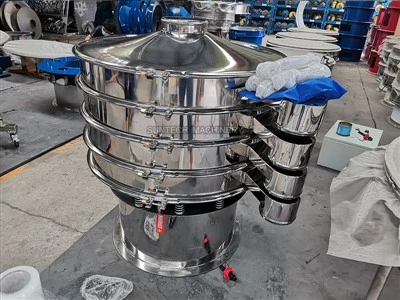
The working state of the vibratory separator effectively mimics the screening machinery of human manual movement and process. Its unique design cleverly combines the sieve (planar circular motion), the Dustpan (to, the parabolic movement), the material in the equipment to do the horizontal and throwing three-dimensional rolling movement, from the Center to the outer edge evenly dispersed, with the spiral movement to the axial propagation. When the spinning sieve works, the motor drives the Sieve machine to do the space three-dimensional curve, this curve is projected as a circle on the plane. The projection on both vertical surfaces is elliptical. Adjusting the eccentric speed of the motor can change the movement trajectory of the material on the sieve surface, so that the sieve body produces a flat vertical composite vibration, to achieve the purpose of screening.
The material is feed from the middle of vibratory separator, and the movement distance of the material on the screen is basically the same, which can guarantee a very accurate screening process. The radial angle and tangential angle of the spinning sieve make the material move involute on the screen, and its design allows the material to walk through the phase on a smaller area. For long roads, the mesh time of the material is longer than that of other types of sieves. Adjusting the radial angle and tangential angle can adjust the accuracy and yield of the sieve.
Rotary vibrating screen model
Rotary vibrating screen mainly includes DH-600, DH-800, DH-1000, DH-1200, DH-1500, DH-1800, DH-2000 and other models. Different types of rotary vibrating screen have different sieve sizes and sieve weights.
Different types of rotary vibrating screen type
According to different materials, it can be classified into all-carbon steel rotary vibrating screen, standard-type rotary vibrating screen, all-stainless steel rotary vibrating screen, and plastic rotary vibrating screen:
Standard rotary vibrating screen
A combination of carbon steel and stainless steel. The contact surface between the body and the material is made of 304 stainless steel, and the base is made of ordinary carbon steel.
All stainless steel rotary vibrating screen
The whole machine is made of 304 stainless steel, the screen machine is strictly polished, welded and polished to meet the diverse needs of users.
All carbon steel rotary vibrating screen
Carbon steel material, low cost, suitable for general material screening and filtering, suitable for products with low budget cost, small demand, and low product requirements.
Plastic rotary vibrating screen (polypropylene vibrating screen)
This type of model is less and has a limited scope of application. It is mainly used under strong acid and strong alkali conditions.
Customized type of rotary vibrating screen
Plus-edge rotary vibrating screen
This kind of vibrating screen expands its inlet on the basis of ordinary vibrating screen, supplemented by special angle design to prevent liquid splashing filtration technology, so as to save cost, reduce waste and increase workload.
Gate type rotary vibrating screen
The main purpose of the design is to remove impurities. The main working principle is to control the in and out of materials by controlling the gate, so as to achieve the purpose of good screening and reduce the manual workload.
Features Difference
①High efficiency, exquisite design, easy to change the screen, simple operation, easy to clean.
②The new screen structure with long service life, and it only takes 3-5 minutes to change the screen.
③It takes up small space and is easy to move, and the discharge port can be rotated 360 degrees at will.
④Fully enclosed structure, no dust flying, no clogging of mesh, and screening can reach 500 mesh.
①Simple structure, convenient installation and easy maintenance.
②Low energy consumption, high output, single-layer and multi-layer screens can be used, and the service life is long.
Working Principle Difference
Through the eccentric hammer installed up and down the vertical vibration motor, the rotary motion of the motor is transformed into horizontal, vertical and inclined three-dimensional motion, and then this motion is transmitted to the mesh surface, changing the phase angle of the upper and lower weights of the motor can change the material movement direction.
Linear vibrating screen
Driven by dual vibration motors, the two motor shafts have an inclination angle relative to the screen surface. Under the combined force of the exciting force and the self-gravity of the material, the material moves forward in a straight line on the screen surface in a jumping style.
Application Difference
Mainly used in chemical industry, food, metal metallurgy mining, pollution treatment, etc.
Chemical industry: Resins, coatings, industrial medicines, etc.
Food industry: Powdered sugar, starch, salt, rice flour, etc.
Metal metallurgy and mining: Aluminum powder, lead powder, copper powder, manganese dioxide, etc.
Mainly used in plastics, abrasives, medicine, building materials, food, fertilizer and other industries.
Such as: Powder, granules, etc.
The rotary vibrating screen is mainly composed of screen cover, screen frame, motor (vibration source), rubber spring, base, etc.
Metallurgical industry
In the metallurgical industry, the application of rotary vibrating screens is also very important. It can finely screen various metal powders, remove impurities and waste, and improve the recovery rate and purity of metals. For example, in the production of steel, non-ferrous metals and other products, rotary vibrating screens can be used to screen various metal powders, ensuring the quality and purity of metal products.
Environmental protection industry
In the environmental protection industry, rotary vibrating screens can also play an important role. It can finely screen various solid waste, classify different types of garbage, and improve the efficiency and environmental friendliness of garbage treatment. For example, in the treatment of urban garbage, waste residue, and other items, rotary vibrating screens can be used to screen different types of garbage, facilitating subsequent classification and recycling.
Chemical industry
In the chemical industry, rotary vibrating screen is one of the essential equipment. It can finely screen various powders, particles, and other materials, remove impurities and waste, and improve the purity and quality of the materials. For example, in the production of pigments, dyes, coatings and other products, rotary vibrating screens can be used to screen various chemical raw materials and intermediate products, ensuring the stability and quality of the products.
The pharmaceutical industry
In the pharmaceutical industry, rotary vibrating screens are also one of the most important equipment. It can finely screen various pharmaceutical raw materials, remove impurities and waste, and ensure the purity and quality of drugs. For example, in the production of Western medicine, traditional Chinese medicine and other products, rotary vibrating screens can be used to screen various chemical drugs and Chinese medicinal materials, ensuring the purity and quality of drugs.
Food industry
In the food industry, the application of rotary vibrating screens is also very extensive. It can finely screen various food additives to remove impurities and waste, ensuring the safety and quality of food. For example, in the production of products such as sugar, salt, and seasonings, rotary vibrating screens can be used to screen various food additives, ensuring the quality and taste of the food.
How to Adjust the Upper and Lower Weights of the Rotary Vibrating Screen
Rotary vibrating screen is a high-precision fine powder screening machine with low noise and high efficiency. It is a fully enclosed structure suitable for screening and filtering materials such as particles, powder, and mucus. It is widely used in fields such as traditional Chinese medicine and filtration. According to different applications, rotary vibrating screens can be divided into ordinary types, gate types, and edge added types.
Among them, the ordinary rotary vibrating screen is mainly designed for the screening operation of ordinary powder and small particle materials; Gate type rotary vibrating screens are commonly used for screening ultra light and ultra-fine materials. Users can perform long-term screening operations by controlling the opening and closing of the gates. This type of screening operation is commonly used in industries such as traditional Chinese medicine powder and pollen; The edge type rotary vibrating screen is a filtering screening equipment that increases the feed inlet on the basis of the ordinary rotary vibrating screen and is designed at a special angle to prevent liquid splashing. It has a wide range of applications in industries such as paint, water filtration, and pulp filtration.
Adjust additional weight blocks according to demand
Through observation, it can be found that an additional weight block is installed on one side of the upper and lower weights (upper and lower eccentric blocks) of the rotary vibrating screen, which increases the excitation force of the screen machine. Users can increase or decrease additional weight blocks based on the number of layers and material density of the screening machine, in order to achieve a more satisfactory screening effect.
Adjusting the phase angle of the upper and lower weights
Due to the non adjustable angle of the upper hammer of the rotary vibrating screen, the user needs to open the bottom bucket adjustment hole, loosen the fixing bolt of the lower hammer, and adjust the phase angle of the upper and lower weights in the opposite direction of the discharge port according to the trajectory of the screened material. Then place a small amount of material on top of the screen, run the screening machine, and check the movement trajectory of the material on the screen surface. When the processing parameters have achieved good results, stop the machine and tighten the fixing bolts to complete the adjustment work (remember to tighten the fixing bolts).
Rotary vibrating screens are comprised of components that move and vibrate during screening operations. Hence, there might be some parts that might have been displaced. Others might even need some repairs or replacements after a long time of use. Checking the level of oil, stroke length and angles, as well as the bolts joints should be conducted every week. Additionally, assessment over the condition of screening media, wear parts, and springs must be done weekly. Upon these checks, you can eventually point out if some parts need to be replaced, repaired, or tightened.
One maintenance tip that you can do with your rotary vibrating screen is to assess the condition of your bearings. Once you have found out that your bearings tend to overheat, produce unusual noise during operations, or obtain significant clearance between the outer ring and the rollers, then you have to replace them right away. Bearings tend to deteriorate pretty easily since they work alongside shock-type loads. The rotary motion of most bearings, likewise, can affect their longevity in the long run.
Just like the bearings, the screening media of your rotary vibrating screens tend to receive a lot of workloads. With continuous usage of rotary vibrating screens, some parts of it can eventually get damaged. All supporting bars of the media must be inspected for corrosion and visible damages. If you have spotted some warped or worn parts, then you must replace them as soon as possible. The capping/channel rubber must also be replaced alongside the screening media, ensuring that the screening process takes place optimally. All nuts and bolts that are integrated with the screening media must also be inspected and replaced whenever necessary. Tension plates or rails must also be replaced for appropriate tensioning.
Excessive heating and welding the screen body of the rotary vibrating screen is not recommended. However, there are cases where welding is necessary to keep the machine running before conducting maintenance. If welding is needed, you must assess and document first the reasons behind the occurrence of cracks before repairing them. You must also make sure that no elements will penetrate the surface of the bearings. Additionally, welding must be done on both sides of the plate.
We're well-known as one of the leading rotary vibrating screen manufacturers and suppliers in China. If you're going to wholesale rotary vibrating screen made in China, welcome to get quotation from our factory. Also, customized service is available.
automatic sand sieving machine, industrial sieve machine, Cement Linear Vibrating Screen(0/10)
