Advanced Equipment
We have Laser Cutting Machine, CNC bending machine, Spot Welding Machine, Polishing Machine,Fixed bench press, air plasma cutting machine, platform CNC punch, CNC hydraulic guillotine shear, four-column hydraulic press, universal lifting table milling machine, radial drilling machine, hydraulic digital display sheet Bending machine,
Production Market
Our products have been exported to Russia, USA, France, Namibia, Saudi Arabia, Thailand, Uruguay, Singapore, Spanish, Germany, Cyprus,Botswana, Korea, Switzerland,Newzeland, Pakistan, Brazil, Malaysia, Spanish, Peru, Chile,Turkey, Portugal, etc.
Our produck
Our produck have Vibrating Screen, Screw Conveyor, Belt Conveyor, Vacuum Conveyor, Bag Dumping Station.
Quality Management
We are qualified with ISO quality management system and CE certificate, all the main components are fine manufactured in our own factory with strict inspection, and quality is always our priority.
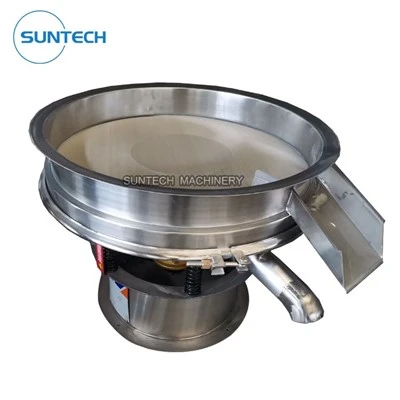
Vibrating filter sieve is a vibrating screening and filtering equipment used in the food industry, the chemical industry and other industries to process liquid materials with little production or less impurities. The filter vibrating screen has a compact structure and adopts a new type of vertical vibrating motor as the vibration source. The upper and lower ends of the vertical vibrating motor are equipped with eccentric weights, which can produce horizontal, vertical, and inclined three-dimensional motions. The exciting force is transmitted through the receiving plate. To the screen frame and materials to achieve excellent classification. By adjusting the phase angle of the upper and lower eccentric weights, the movement trajectory of the material on the screen surface can be changed to ensure that the material is fully classified.The vibrating filter sieve is excited by a heavy hammer driven by a motor, and the screen body produces horizontal, vertical, and inclined three-dimensional motion, so that the material is thrown up on the screen and rotates from the center to the outside to be discharged from the discharge port. The material is on the screen. During the movement, fine particles or liquids pass through the screen, and the materials can be screened, classified or filtered by selecting and installing the corresponding screen and the number of screen layers, and the sorted materials are automatically discharged from their respective outlets.
Application of Vibrating Filter Sieve
Filtration: Used to filter out solid particles or impurities in the liquid. This helps to purify the fluid and remove unwanted contaminants or debris. Industries such as pharmaceuticals, food and beverage, and water treatment rely on vibrating filter sieve for efficient filtration processes.
Particle size classification: It can be used to classify or separate particles according to their size. By using sieves of different mesh sizes, the machine can retain particles of a specific size while allowing smaller or larger particles to pass through. This is useful in industries where particle size control is critical, such as chemical processing or mining.
3Clarification: To clarify liquids by removing suspended solids. By passing liquid through a fine mesh or strainer, the machine traps solid particles and allows clarified liquid to pass through. This is common in applications such as wastewater treatment or juice clarification in the beverage industry.
Material recovery: Used to recover valuable materials from liquid-solid mixtures. By separating out the solid particles, the machine can collect and extract the valuable components present in the liquid. This is common in industries such as mining, where separation and recovery of minerals or metals from slurries is critical.
Beverage and brewing industry: Used in the beverage and brewing industry to remove solids, sediments and impurities from liquids such as fruit juice, wine and beer. They help achieve clarity, remove particulate matter and maintain product consistency and quality.
Paint and Coatings Industry: Fluids are critical in the paint and coatings industry to ensure the desired consistency and quality of the final product. They remove agglomerates, contaminants or oversized particles from liquid paint or coating formulations, resulting in smooth, uniform coatings.
Wastewater Treatment: Wastewater treatment plants use vibrating filter sieve to remove solid particles and impurities from water before discharge or further treatment. They aid in the removal of suspended solids, sludge dewatering, and the reduction of overall pollutant levels in wastewater.
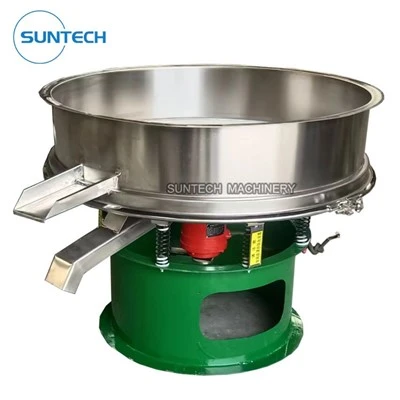
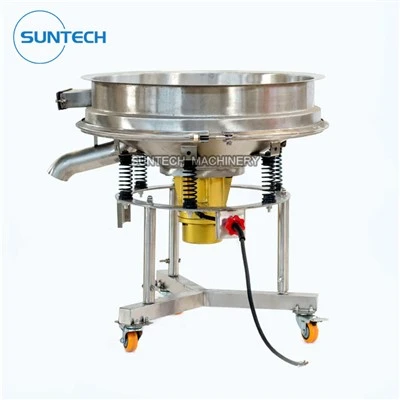
Vibrating filter sieve consists of machine body, vibration motor, outlet hopper, sieve griddle-control device.
Body: The filter sieve is made of high-quality stainless steel, rust-proof and corrosion-resistant, and has a compact and sustainable design.
Discharge port: Wide discharge port to ensure rapid discharge without clogging.
Vibration motor: The 50W powerful vibration motor has no mechanical transmission, so that there is no loss in the transmission process of the exciting force and the efficiency is maximized.
Sieve: According to your needs, it can be adapted to different sieve sizes. The 40-mesh sieve is suitable for sieving flour, and the 60-mesh sieve is suitable for sieving powder.
Dust-proof cover: The cover can be selected to seal it, which greatly enhances the sealing performance and prevents the powder from splashing during shaking.
|
Eral requirements |
Diameter Size(mm) |
400/800/1000/1200/1500/2000 |
|
Number of Layers(L) |
1 |
|
|
Main Material |
Stainless Steel(304/316L)•Carbon Steel(Q235) |
|
|
Screen Mesh Number |
5-500 |
|
|
Sealing Strip |
Silica gel / Rubber |
|
|
Special requirements |
Overall height of the fuselage |
Please communicate specifically |
|
Feed inlet |
Angle / Size and so on |
|
|
Outlet |
Angle / Size /Add valve |
|
|
Observation port |
Silicone cover / Rubber cover / Glass cover |
|
|
Spring |
You can choose whether to add a silicone protective cover |
|
|
Internal spray(mm) |
PTFE / ePTFE / WC / Al2O3 |
|
|
Equipment surface treatment |
Polishing / Sandblasting |
|
|
Body metal material requirements |
For example: require no Cu and Zn (except electrical parts) |
|
|
Vibration motor |
Ordinary motor / Explosion-proof motor |
|
|
Other |
Can be customized |
What Is the Difference Between Filter and Vibrating Filter Sieve
Working principle of slurry filter sifter
Filters use different pore sizes to screen impurities and particles. Usually, paper, cotton cloth or filter screens are used. These pore sizes will not change. Different filtering effects can be achieved through paper, cotton cloth or filter screens with different pore sizes. . Filters remove desired substances from a fluid while retaining unwanted substances.
The sieve is used to separate the impurities and particles in the material by using the different sieve size. Usually, metal wire mesh or plastic mesh is used, and the sieve size can be adjusted to achieve different screening effects. The sieve is used to sort out the desired substances among the particles and keep the unwanted substances.
Slurry filter sifter usage scenarios
Filters and sieves are used in different scenarios. Filters are commonly used to handle liquid substances such as water, oil, and beverages. For example, the paper filters we use when filtering tea leaves, the filter elements used in water purifiers, the oil filters used in mechanical processing, etc., all use filters to filter unwanted impurities.
Sieves are usually used to process substances, such as sieving powder in food processing, sieving medicinal materials in the pharmaceutical industry, and so on. The size of the sieve can be adjusted according to the particle size of the separated material, and the required material and particles can be selected through the size of the required sieve hole.
Slurry filter sifter processing capacity
Filters and sieves have different capacities. Typically, filters have a higher capacity than sieves. The filter is based on the original pore size of paper, cotton cloth, filter screen, etc. to filter unnecessary impurities, and different filtering effects can be achieved through filter materials with different pore sizes. The sieve is to separate the granular material through the size of the sieve hole, and adjust the size of the sieve hole according to the size of the required material, so the particle size processed by the sieve is smaller than the processing capacity of the filter.
What Are the Precautions for Vibrating Filter Sieve Operation
Wear proper personal protective equipment
Always wear appropriate PPE, such as safety glasses, gloves, and hearing protection, when operating or working near a vibrating filter sieve. This will help protect you from potential hazards, including flying debris and excessive noise.
Conduct pre-operation inspection
Before starting the vibrating filter sieve, visually inspect the machine for any signs of damage or wear. Check for loose bolts, damaged screens, and any abnormalities. Ensure that all guards and safety devices are in place and functioning properly.
Securely mount and level the screen
Make sure the vibrating filter sieve is securely mounted on its support structure or floor and properly leveled. This helps prevent excessive vibrations, ensures smooth operation, and minimizes stress on the machine.
Monitor vibrating screen performance
Regularly monitor the performance of the vibrating filter sieve during operation. Pay attention to unusual vibrations, noises, or changes in screening efficiency. If any issues arise, promptly shut down the machine and address the problem.
Maintain proper lubrication
Proper lubrication helps reduce friction and wear, extending the lifespan of components and ensuring smooth operation.
Avoid overloading
Do not overload the vibrating filter sieve vibrating screen beyond its designed capacity. Overloading can cause excessive stress on the machine and lead to premature wear or failure of components.
Clean and maintain the screen
Regularly clean the screen to prevent material buildup, which can affect screening efficiency. Additionally, perform routine maintenance tasks, such as tightening bolts, inspecting screens for wear, and replacing damaged or worn parts.
A sieve and a screen are both used in separation techniques, but they have different applications and characteristics.
A sieve is a device with uniform, regularly spaced openings for separating particles of different sizes. It is commonly used in industries such as agriculture, food processing, and construction.
On the other hand, a screen typically refers to a mesh or net-like material used to separate solid particles from liquid or gas. Screens are often used in filtration processes, such as in water treatment or air purification systems.
While both sieves and screens are used for separation, sieves are specifically designed for separating particles based on size, whereas screens are more broadly used for separating solids from liquids or gases.
We're well-known as one of the leading vibrating filter sieve manufacturers and suppliers in China. If you're going to wholesale vibrating filter sieve made in China, welcome to get quotation from our factory. Also, customized service is available.
vibrating sieve, square vibrating sieve machine, vibro sifter sieves(0/10)



