




Can an ultrasonic vibro sifter be used for screening materials with different moisture contents?
 Dec 19, 2025|
 As a well - established supplier of ultrasonic vibro sifters, I've often been asked about the versatility of our equipment, especially regarding its ability to screen materials with different moisture contents. This topic is not only crucial from a practicality perspective but also has a significant impact on many industrial processes.

Moisture Content: A Key Factor in Material Screening
Moisture content can dramatically affect the physical properties of materials. When a material has a high moisture content, it tends to clump together. For example, in the food industry, grains or powders with elevated moisture can form agglomerates. These clumps are much larger than the individual particles of the material, and they can block the mesh of a traditional sifter, leading to reduced screening efficiency and inaccurate particle size separation.
On the other hand, materials with low moisture content can be too dry, causing them to generate static electricity during the screening process. The static charge makes the particles adhere to each other and to the sifter's mesh, also creating problems in the screening operation.
How Ultrasonic Vibro Sifters Work
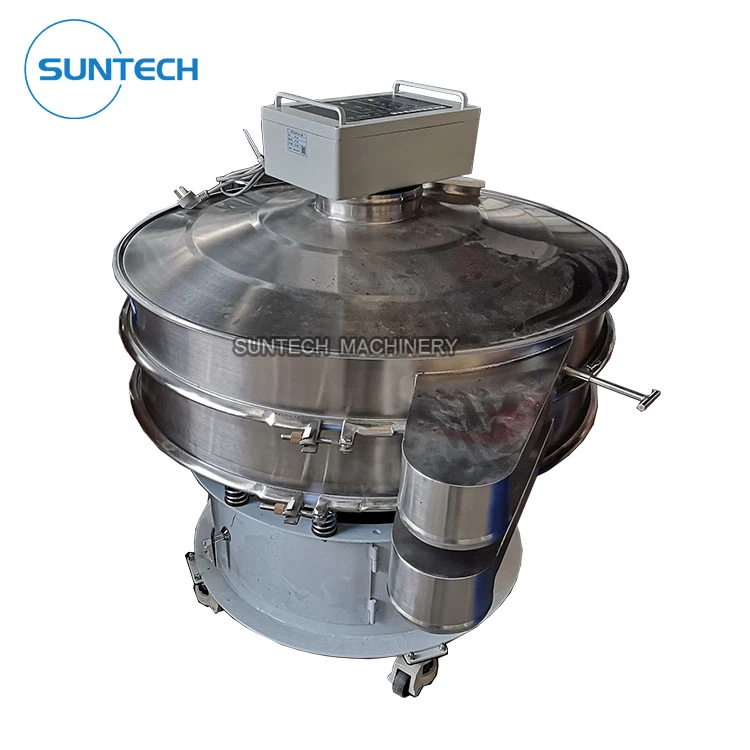
An ultrasonic vibro sifter is a revolutionary piece of equipment that combines the principles of vibration and ultrasonic technology. At its core, the sifter uses a vibrating motor to create a multi - dimensional vibration, which helps in moving the material across the mesh for screening. But what sets it apart is the ultrasonic system. The ultrasonic transducer generates high - frequency ultrasonic waves that are transferred to the sieve mesh. These waves break the surface tension between particles and the mesh, preventing particles from clogging the openings.
Screening Materials with High Moisture Content
When it comes to high - moisture materials, our ultrasonic vibro sifters have shown remarkable performance. The ultrasonic waves can break up the clumps formed due to moisture. For instance, in the pharmaceutical industry, when dealing with wet granules, the ultrasonic energy disrupts the bonds between the moist particles, allowing them to pass through the sieve more easily.
The vibration of the sifter also plays a crucial role. The continuous movement of the sieve helps in spreading the material evenly, reducing the chances of large clumps accumulating in one area. The combination of vibration and ultrasonic waves ensures that the screening process remains efficient even for materials with moisture contents that would cause problems for traditional sieves.
We have a Small Ultrasonic Automatic Vibrating Screen Sieve, which is particularly useful for small - scale operations dealing with high - moisture materials. Its compact design and powerful ultrasonic technology make it suitable for laboratories or small production lines where high - precision screening is required.
Screening Materials with Low Moisture Content
For materials with low moisture content, the problem of static electricity can be effectively mitigated by ultrasonic vibro sifters. The ultrasonic waves disrupt the static charge between the particles. In the chemical industry, where fine powders with low moisture are common, the sifter ensures that the particles remain separated and pass through the sieve smoothly.
The high - frequency vibrations also help in loosening any particles that may have adhered to each other due to static forces. The Ultrasonic Vibrating Screen for Starch is an excellent example of our product designed to handle low - moisture and static - prone materials like starch. It is equipped with advanced ultrasonic technology to ensure efficient screening of such fine powders.
Advantages of Using Ultrasonic Vibro Sifters for Moisture - Diverse Materials
- High Efficiency: Compared to traditional sieves, ultrasonic vibro sifters can screen materials with different moisture contents much faster. The combination of vibration and ultrasonic waves speeds up the screening process, leading to higher productivity.
- Accurate Particle Separation: The ability to break up clumps and eliminate static ensures that the sifter can accurately separate particles according to their size, regardless of the moisture content of the material.
- Reduced Maintenance: Since the ultrasonic waves prevent mesh clogging, there is less wear and tear on the sieve mesh. This reduces the frequency of mesh replacement and overall maintenance costs.
Case Studies
Let's take a look at some real - world examples to illustrate the effectiveness of our ultrasonic vibro sifters in screening materials with different moisture contents.
A food processing company was having trouble screening a high - moisture spice blend. Traditional sieves were constantly getting clogged, and the screening process was slow and inefficient. After implementing our ultrasonic vibro sifter, specifically the Ultrasonic Round Vibrating Screen Sieve, the company saw a significant improvement in productivity. The ultrasonic waves broke up the clumps, and the vibration ensured a smooth flow of the spice blend through the sieve.
In another case, a powder coating manufacturer was struggling with the screening of low - moisture powder particles that were prone to static. Their old sifting equipment was unable to achieve the desired particle size separation. But with our ultrasonic vibro sifter, the problem was solved. The ultrasonic technology eliminated the static charge, and the powder was screened accurately and efficiently.
Factors Affecting the Performance on Different Moisture Materials
While ultrasonic vibro sifters are highly effective, there are a few factors that can influence their performance when screening materials with different moisture contents.
The type of material itself is crucial. Some materials may have a chemical composition that makes them more resistant to the effects of ultrasonic waves. For example, materials with a high viscosity even at low moisture levels may require a more powerful ultrasonic system to achieve optimal screening.
The degree of moisture variance also matters. If the moisture content of the material fluctuates significantly during the screening process, it can pose challenges. In such cases, it may be necessary to adjust the settings of the ultrasonic vibro sifter, such as the intensity of the ultrasonic waves or the vibration amplitude.
Conclusion
In conclusion, an ultrasonic vibro sifter is a highly versatile tool that can indeed be used for screening materials with different moisture contents. Whether it's high - moisture clumping materials or low - moisture static - prone ones, our ultrasonic vibro sifters offer efficient and accurate screening solutions.
If you are in search of reliable screening equipment for materials with diverse moisture levels, our range of ultrasonic vibro sifters can meet your needs. We have a team of experts ready to provide technical support and guidance to ensure that you find the perfect sifter for your specific application. Don't hesitate to contact us for a detailed discussion on how our products can enhance your screening processes.
References
- Smith, J. (2018). Advances in Screening Technology for Wet and Dry Materials. Journal of Industrial Engineering, 25(3), 123 - 135.
- Brown, A. (2020). The Impact of Moisture on Particle Screening Processes. Powder Technology Journal, 352, 456 - 468.
- Green, C. (2019). Ultrasonic Vibration in Material Screening: A Review. Industrial Applications Magazine, 18(4), 67 - 78.